After making the first foil lids, inspection hatches and water windows, I already knew a lot about what CALYXA® would need. But one question was still unanswered: What shape should the lid have to work perfectly?
Every idea built on the previous one. Every mistake taught something new. And slowly, the final shape began to reveal itself.
🔶 1. The Container Shape
Square with rounded corners — the base everything else was built on
The final container shape came from the one I used the most in experiments: a square form with slightly rounded corners. Round would have made it difficult to position the airflow gap and caused problems with lid alignment. Square was practical, sturdy and easy to handle.
🏠 2. The Lid Could Not Sit Tightly — the Air Gap Was Mandatory
5 mm airflow gap — a deliberate design requirement, not an accident
From my Kratky experiments, I had learned one crucial thing: the roots must have a space where air can reach them. If the lid were airtight, oxygen roots would not form and growth would stop.
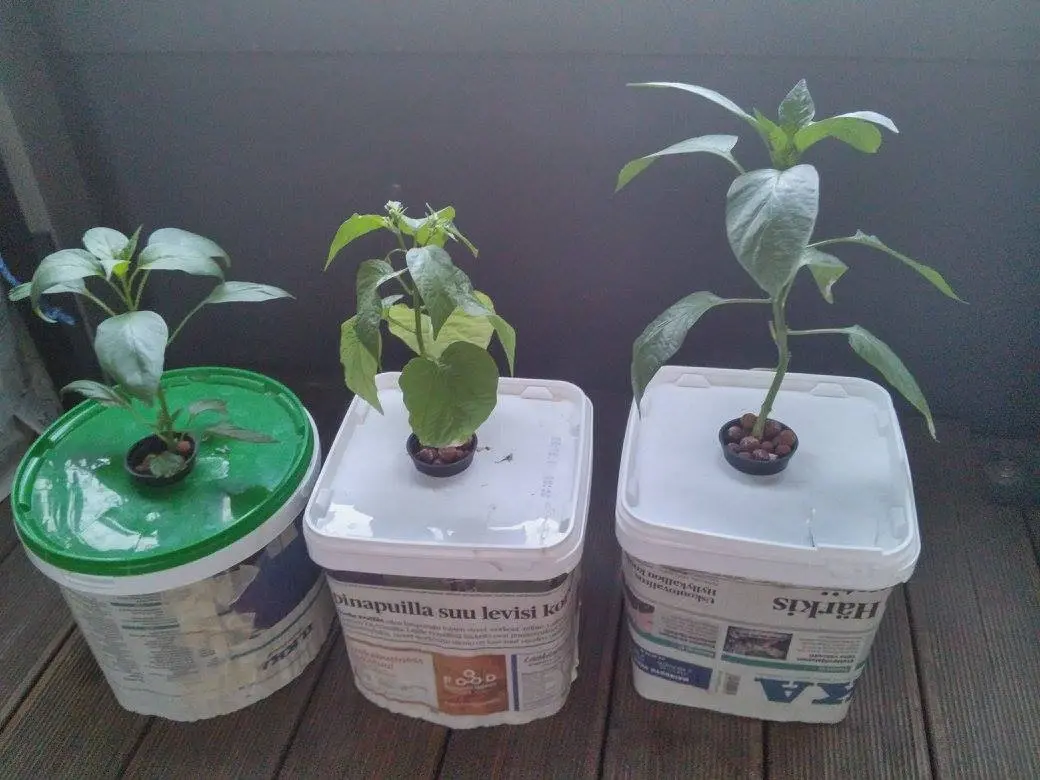
Because standard Kratky containers are sealed, no pressure differential can form. Without an air gap or convection channel, oxygen cannot reach the upper root zone, and the system collapses into anaerobic stagnation.
Decision: the lid must be wider than the container, and it must create a consistent 5 mm airflow gap all around.
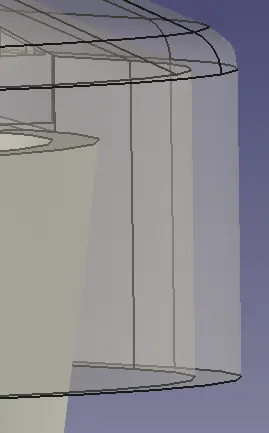
The 5 mm gap and the 20 mm eave edge — both visible in this CAD cross-section view. The lid overhangs the container wall to create perfect light-tightness while keeping the air gap open.
🏡 3. The Eave-Shaped Edge — 20 mm Down the Outside
Inspired by the eaves of a house
When thinking about how the lid should sit, an image came to mind: the eaves of a house. Eaves protect, guide water, block light, and allow air to move — exactly what the CALYXA® lid needed.
I designed a lid edge that extends 20 mm down the outside of the container — creating perfect light-tightness while still leaving the 5 mm airflow gap for the roots. This structure is now part of the EUIPO design protection.
⛰️ 4. Raising the Center by 20 mm — the "Bungalow Roof"
A shape that solves condensation
If the lid were completely flat, condensation would drip randomly onto the roots and run down the outside of the container. So I raised the center of the lid by 20 mm — like a small bungalow roof — collecting moisture and guiding it toward the edges.
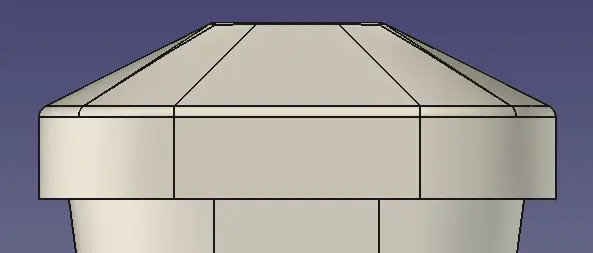
The "bungalow roof" dome — the 20 mm raised center that collects condensation and guides it toward the edges, where the Air Flow Wings™ return it to the reservoir. The diamond facet pattern is molded into this surface.
This roof-like surface is also where the diamond-shaped facet pattern is molded — scattering light under the plant while keeping the internal temperature stable.
🪽 5. Air Flow Wings™ — Born From the Need to Move Air
Four wings that direct air and return condensation
Once I had the 5 mm airflow gap, I asked: "How do I make the air move purposefully inside the lid?" The solution was four thin wings that direct air toward the roots — with small vertical grooves at the back of each wing to catch condensation and guide it back into the container.
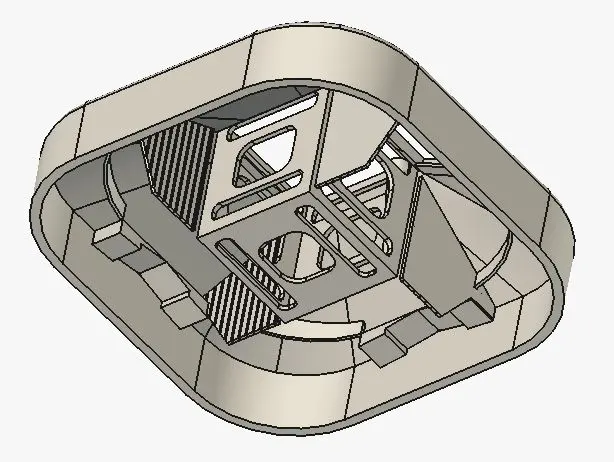
Top-down view of the lid interior — all four Air Flow Wings™ visible (green), the Air pot opening in the center, condensation channels, and the 16 Pyramid Locking System™ contact points around the perimeter.
💧 6. Condensation Control Ridge
Stopping condensation from dripping outside
While designing the wings, I noticed a new problem: if condensation runs along the inner surface of the lid, it could drip outside the container and wet the table. So I developed a small raised ridge inside the lid — positioned within the inner dimensions of the container — that stops condensation and guides it back into the reservoir.
A 1×2 mm ridge inside the lid guides condensation safely back into the container. Small detail, big consequence.
🌟 The Complete Picture
All elements working together
All these ideas — one by one — built upon each other: the container shape, the wider lid, the 20 mm eave, the 20 mm dome, the square Air pot, the Air Flow Wings™, the condensation-control ridge.
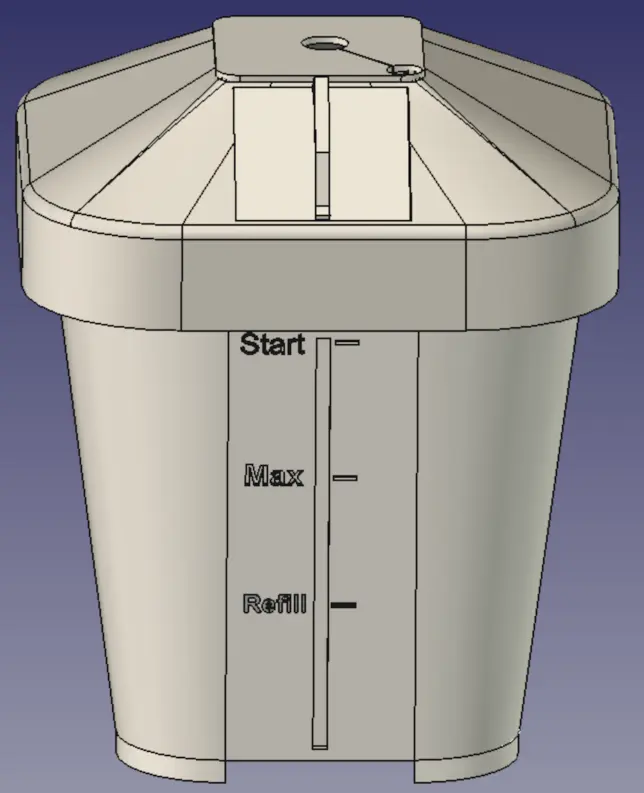
CALYXA® assembled — every lid element visible in the final form
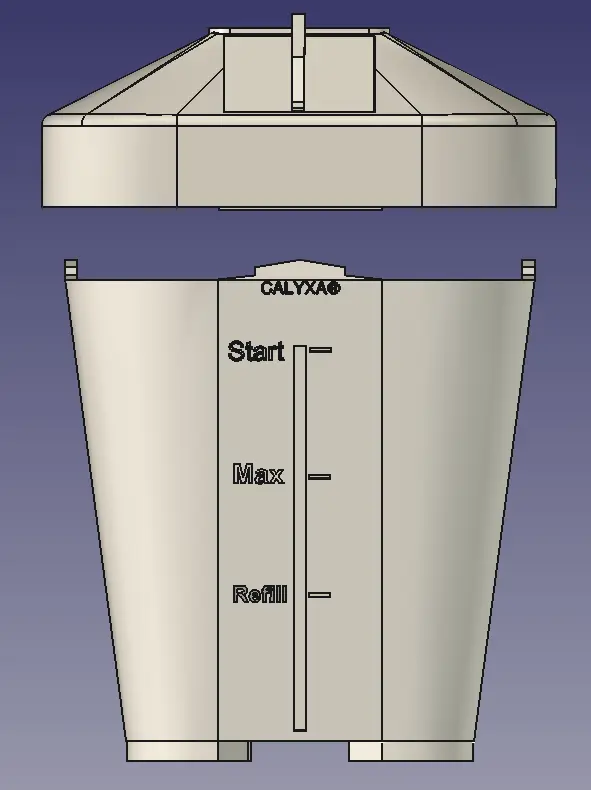
Lid separated — dome, wings, Air pot, condensation ridge, locking points
"This is no longer a Kratky hack. This is a finished product. This is CALYXA®."
But there was still one more challenge: how to make the entire structure work together without making the lid airtight? That answer came with the invention of the Pyramid Locking System™.